
Introduction
Jurisprudence is the theoretical foundation of law. While other subjects explain what the law is, jurisprudence explains why law exists, how it develops, and what it ought to be. For a law student, jurisprudence is not merely an academic subject but a powerful tool that sharpens legal reasoning, interpretation, and analytical thinking.
Meaning of Jurisprudence
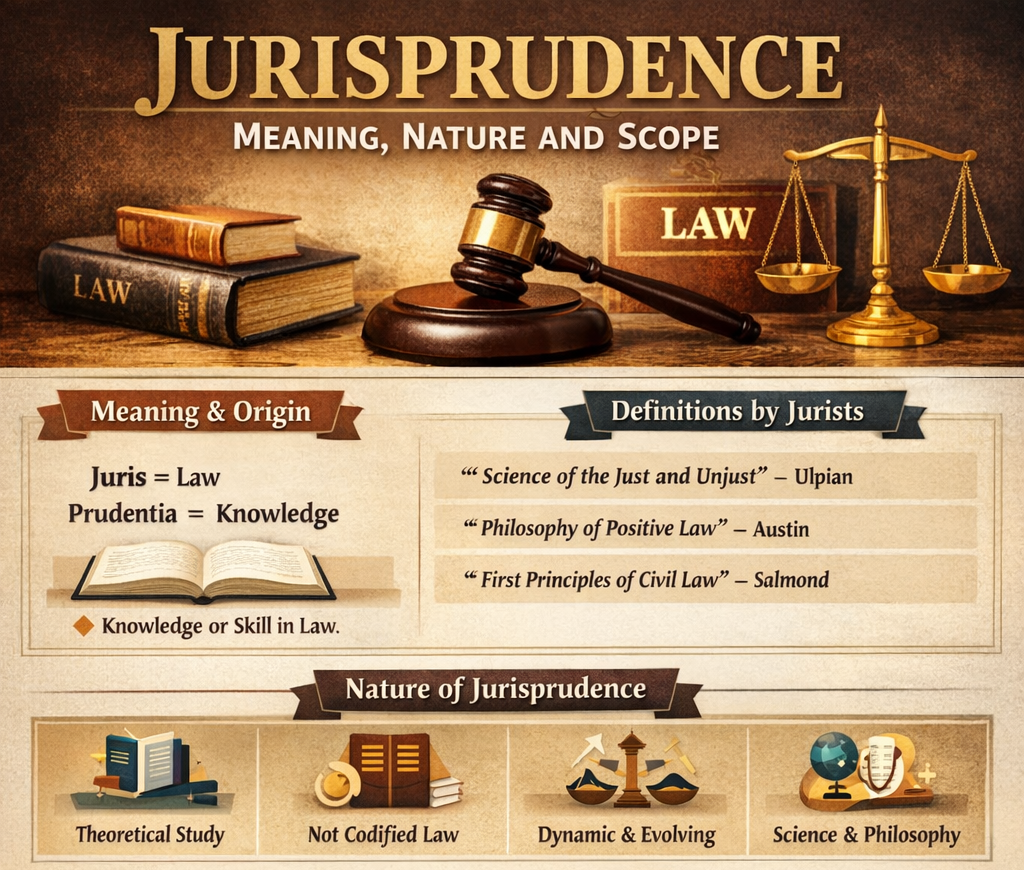
The word Jurisprudence is derived from two Latin words:
- Juris – Law
- Prudentia – Knowledge or skill
👉 Therefore, Jurisprudence means the knowledge or skill in law.
Definitions by Jurists
Ulpian : Jurisprudence is the knowledge of things divine and human, the science of the just and unjust.
Austin : Jurisprudence is the philosophy of positive law.
Salmond : Jurisprudence is the science of the first principles of civil law.
📌 Exam Tip: Austin’s definition is the most frequently asked in exams.
Nature of Jurisprudence
The nature of jurisprudence can be understood under the following heads:
1. Jurisprudence is a Theoretical Study
It deals with general legal principles rather than specific laws of a country.
2. Jurisprudence is not Codified Law
It is not enacted by the legislature but developed by jurists through reasoning and philosophy.
3. Jurisprudence is Dynamic
Law evolves with society, and jurisprudence studies this evolution.
4. Jurisprudence is Both Science and Philosophy
- Science → systematic study of legal principles
- Philosophy → justice, morality, ethics
Illustration:
In Kesavananda Bharati v. State of Kerala, the Supreme Court evolved the Basic Structure Doctrine, reflecting jurisprudential reasoning beyond the literal text of the Constitution.
Scope of Jurisprudence
The scope of jurisprudence is very wide and varies according to jurists:
According to Austin:
Limited jurisprudence to positive law (law laid down by political superiors).
According to Salmond:
Included:
- Nature of law
- Sources of law
- Rights and duties
- Administration of justice
Modern View:
Modern jurisprudence includes:
- Sociological aspects of law
- Economic and political influence on law
- Human rights
- Judicial activism
- Legal interpretation
Case Law:
In Maneka Gandhi v. Union of India, Article 21 was expanded by interpreting “procedure established by law” as just, fair and reasonable.
Subject Matter of Jurisprudence
Jurisprudence mainly deals with:
- Nature and definition of law
- Sources of law (Custom, Precedent, Legislation)
- Rights and duties
- Legal personality
- Ownership and possession
- Civil and criminal liability
- Administration of justice
Importance of Jurisprudence
Jurisprudence is important because it:
- Helps in proper interpretation of law
- Improves legal reasoning skills
- Assists judges in deciding complex cases
- Guides legislators in law-making
- Forms the foundation for advanced legal studies
📚 Example:
In Vishaka v. State of Rajasthan, guidelines were framed in the absence of legislation, showing how jurisprudence helps develop law where statutes are silent.
Difference Between Jurisprudence and Law
| Jurisprudence | Law |
|---|---|
| Theoretical | Practical |
| General principles | Specific rules |
| Universal | Country-specific |
| Philosophy of law | Command of law |
Conclusion
Jurisprudence is the soul of law. It enables law students to think beyond statutes and judgments and understand the philosophy behind legal systems. Mastery of jurisprudence not only helps in exams but also creates a strong foundation for legal practice and judicial reasoning.
Frequently Asked Questions (FAQs)
Q1. Is jurisprudence a practical subject?
No, it is mainly theoretical, but it greatly helps in legal reasoning and interpretation.
Q2. Which jurist’s definition is important for exams?
Austin and Salmond are the most important.
Q3. Is jurisprudence asked in judiciary exams?
Yes, extensively.
Bibliography
- Salmond on Jurisprudence, 12th Edition, Sweet & Maxwell
- The Province of Jurisprudence Determined – John Austin
- Jurisprudence – Central Law Agency